Muskegon River Expedition No. 10: Maple Island to Pere Marquette Park
November 15, 2026 | West Michigan
By Brad D. De Young
Cofounder, West Michigan Kayaking Club
The Kayaker's Journal
Some trips you finish in a day. This one took years.
On November 15, 2026, Tim Postma and I paddled the last stretch of the Muskegon River and finished something we had been working toward for a long time: the whole river, all 226 miles of it, from the headwaters near Houghton Lake to the mouth at Lake Michigan. We had paddled it in sections — ten trips in all — in heat and cold, high water and low, with a lot of good people joining us for different pieces along the way.
Tim and I cofounded the West Michigan Kayaking Club, and since then we have spent more days than I can count on Michigan rivers, getting people out on the water. This journey was different, though. It was personal. We started this river together, and we were going to finish it together.
The last leg ran from the Maple Island Boat Launch to Pere Marquette Park in Muskegon. Between those two points: about 20 miles of river, a crossing of Muskegon Lake, and a run out the Muskegon Channel to Lake Michigan.
6:23 A.M. — Coffee, 37 Degrees, and One Last Launch
The alarm went off early, the coffee went down fast, and by 6:23 a.m. we were moving. The overnight low had only dropped to 37 degrees — mild for mid-November in West Michigan, and we weren't complaining.
There is a particular quiet to the hour before a launch. The roads are empty, the river is empty, and your head is already out on the water. Tim and I drove to Maple Island to meet the rest of the group.
Starting location: Maple Island DNR Boat Launch
Bridgeton Township, Newaygo County, Michigan
GPS coordinates: 43.318397° N, 86.033468° W
Maple Island is a public Michigan Department of Natural Resources boat access on the lower Muskegon River, used by boaters, anglers, and paddlers working this part of the river. For us, that morning, it was more than a boat launch. It was the start of the last chapter.

Staging boats at the Maple Island boat launch on the lower Muskegon River — ready for the final leg to Lake Michigan.
Understanding the River: Water Levels, CFS, and the Current
Before a longer trip, it pays to know what the river is doing.
Paddlers talk about flow in CFS — cubic feet per second. It is simply how much water passes a given point on the river every second. More water generally means a stronger push downstream, though the width and depth of the river decide how that actually feels from the seat of a kayak.
For November 15, the USGS flow information near Croton gave us our reference: the reported discharge was approximately 1,690 CFS. That is an upstream reading, not a measurement at Maple Island, but it told us the river was running healthy. It had been flowing well for weeks, and we could feel it once we launched — a steady current that worked with us all morning.
On the moving water we held a pace of about 5.5 miles per hour. There is a point on a good river day when your stroke, the boat, and the current settle into the same rhythm, and the miles start sliding by. That morning, the Muskegon was in that kind of mood.
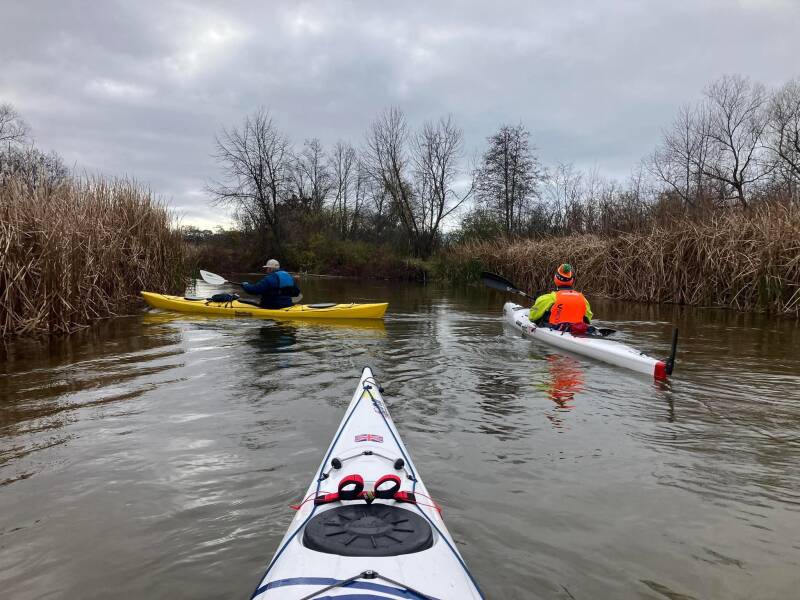
On the lower Muskegon River below Maple Island, paddling reed-lined water toward Muskegon Lake.
The Lower Muskegon: A Changing Landscape
The lower Muskegon has a character all its own, and it changes as you go.
Below Maple Island, the river is wide and slow. The banks are lined with tall reeds and marsh grass, and behind them the woods stand bare — oaks and maples already done with fall, branches black against a gray sky. In places the river feels closed in and quiet, just you and the current and the sound of your own paddle. In others it opens into wetlands and backwater, and you start to feel how close the big water is getting.
Every bend changes something. The current speeds up on the outside of a turn and rests on the inside. The banks rise, then fall away. You can watch the countryside slowly give ground to the lake plain.
By the time you have paddled this far down the Muskegon, you are not just on a river anymore. You are on the last freshwater miles before one of the largest lakes in the world.

A club paddler in an Epic surf ski on the calm lower Muskegon River.
Good Friends Make Great Adventures
Tim and I didn't paddle the final leg alone. James Bruce and Susan made the drive to join us, and the day was better for it.
That is one of the honest truths of this sport: you meet someone at a boat launch, trade a few words over the boats, and an hour later you are deep in conversation between paddle strokes. By the take-out, they are not strangers anymore. Some of the best friendships I have started exactly that way.
We stopped once along the way — about twenty minutes to stretch our legs, use the restroom, and eat a quick lunch on the bank. Nothing fancy. You sit on a log, you eat a sandwich with cold hands, you look at the river you still have to paddle, and you get back in the boat.
Ahead of us was the one part of the day that isn't river at all.
Muskegon Lake.

The group rafted up on the lower river — a short break before the Muskegon Lake crossing.
From River to Lake: Entering Muskegon Lake
Sooner or later, the lower Muskegon runs out of banks.
The river widens, the current lets go of you, and suddenly you are on Muskegon Lake — roughly 4,150 acres of open water, about five miles long, with the city of Muskegon standing across the far shore. It is a working lake: pleasure boats, fishing boats, sailboats, and commercial traffic all share it, and it connects to Lake Michigan through the Muskegon Channel.
River paddling and lake paddling are different things. On a river, the current does half the steering. On a lake, it is wind, waves, and fetch — the distance the wind has to build those waves. There is no bank to tuck against, and conditions can change faster than they do on a protected river.
We got lucky. For November, the wind was unusually light and the lake was nearly calm, with very little wave action to fight. We did get some rain, but nothing that changed the day. You aim the bow at the far shore, settle into your stroke, and watch Muskegon get closer one paddle stroke at a time.
There is a feeling that comes with paddling off a river and onto a lake after following that river for 226 miles. The water opens up in every direction, and it hits you: the river carried you here, and it is almost done carrying you.

Crossing Muskegon Lake — where the river gives way to open water.
The Muskegon Channel: The Gateway to Lake Michigan
Between Muskegon Lake and Lake Michigan sits the Muskegon Channel, a shipping lane that ties the inland lake to the big lake. Freighters and tugboats use it. So do fishing boats, recreational boats, and the Lake Express ferry, which runs across Lake Michigan to Milwaukee.
Moored along the channel is the USS Silversides, the World War II submarine that is now a museum ship. We rafted up alongside her hull for a few minutes — four kayaks against 312 feet of steel — and it is hard not to feel small, in a good way, next to that much history.
The channel ends at the pierheads, where the Muskegon South Pierhead Light stands. Right now the light is wrapped in white covering while it is being restored, so it looks more like a ghost than a lighthouse — but it still marks the door between the channel and Lake Michigan.
This is water that deserves your attention, calm day or not:
● Stay well clear of shipping lanes and vessel approaches.
● Stay visible, and keep an eye on boat traffic at all times.
● Check the wind and waves before you commit to open water.
● Wear a properly fitted personal flotation device.
● Keep an eye on the weather — lake conditions can turn quickly.
● Never assume a large vessel can see you or move around you. A freighter can't stop or turn for a kayak.
For us, the light wind and calm water made the channel a pleasure instead of a problem. Not every November day gives you that.

Passing the Muskegon South Pierhead Light — wrapped for restoration — on the way out to Lake Michigan.
Lake Michigan: The Finish Line
I don't know how to describe the moment you paddle out of a channel and onto Lake Michigan after following a river for 226 miles. I have been turning it over since we landed, and the plain version is the true one: it felt like finishing something that mattered.
Our destination: Pere Marquette Park
3510 Channel Drive
Muskegon, Michigan 49441
Approximate GPS coordinates: 43.22389° N, 86.34778° W
Pere Marquette Park sits on the Lake Michigan shore right at the mouth of the channel — a wide sand beach, the breakwater, the lighthouse behind you, and nothing in front of you but open water all the way to Wisconsin.
We paddled out past the pierheads, turned for the beach, and landed as the light was going. Think about the water for a second: every bit of it started somewhere inland — a spring, a swamp, a small creek up near Houghton Lake — and all of it ends here. On November 15, we followed it the whole way.

On Muskegon Lake under a heavy November sky, closing in on the channel.
A November Adventure: Why the Weather Mattered
November paddling in Michigan is not a casual thing, and we didn't treat it that way.
The water is cold — properly cold, the kind that takes your breath if you go in. The days are short: the sun set at 5:20 that evening, and we came off the water at dusk. Weather can turn within an hour. And November 15 is opening day of firearm deer season in Michigan, which is why you will see blaze orange in our photos — on the river and at the launches, we wanted to be easy to see.
We were fortunate: an overnight low around 37 degrees, light wind, a calm lake, and only some rain to deal with. But the gear mattered as much as the luck — insulating layers and immersion protection, properly fitted PFDs, communication equipment, and a plan we were willing to change if the lake had said no.
That is the rule on big water in cold months: respect it, prepare for it, and never let a goal talk you into conditions you shouldn't be in. The river will still be there.

Tim Postma and Brad De Young at Pere Marquette Park beach, completing the Muskegon River journey.
226 Miles: More Than Just a Number
When Tim and I first talked about paddling the entire Muskegon River, we knew it would take a while. Two hundred and twenty-six miles is a lot of river.
What I didn't fully understand at the start is that the miles would end up being the smallest part of it.
It's the people. The paddlers who joined us for one section and the ones who came back for more. The conversations at boat launches at sunrise. The shuttle drivers, the photographers, the folks who showed up with coffee. Every person who paddled a piece of this river with us owns a piece of finishing it.
There is real satisfaction in being done — and, honestly, a little sadness too. When you spend that long working toward a finish line, crossing it is sweet and strange at the same time. You stand on the beach, and the thing you have been pointing at for years is suddenly behind you.
But here is what I know: it was never really about Lake Michigan. It was about everything between the headwaters and that beach. And I wouldn't trade a mile of it.
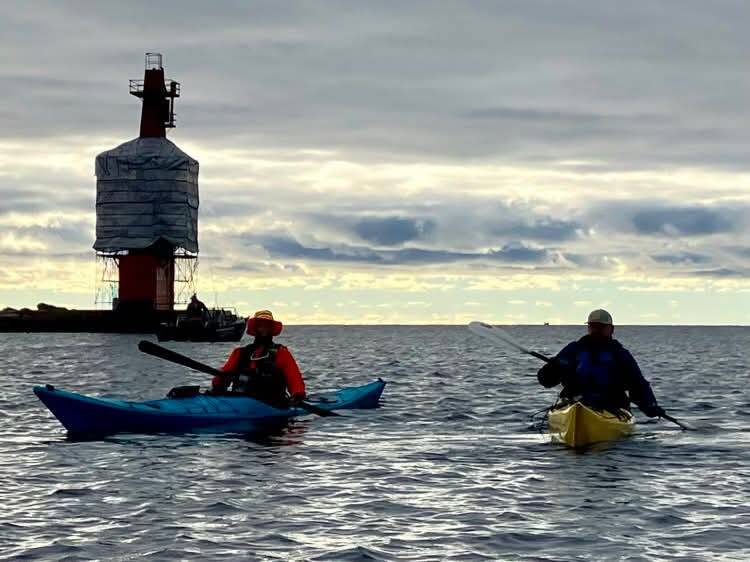
Two of the group paddling past the Muskegon South Pierhead Light at the channel mouth.
The Reason We Started the West Michigan Kayaking Club
Tim and I started the West Michigan Kayaking Club for a simple reason: to get people out on Michigan's waterways, together.
We wanted to build the kind of group where a new paddler could show up at a launch and be welcomed, where experienced paddlers could find a real challenge, and where people could discover what this state actually has to offer — because most people have no idea how much good water is within a short drive of their front door.
This river is a good example. The Muskegon isn't just a place to paddle. It supports wildlife, runs through towns that depend on it, and ties a whole watershed together on its way to Lake Michigan. When you paddle a river end to end, you stop seeing it as scenery. You see it as something alive that deserves looking after.
The Muskegon River gave us 226 miles of memories. That is worth celebrating — and worth protecting.
The River May End, But the Adventures Continue
On November 15, 2026, we finished the Muskegon River — from the headwaters near Houghton Lake to Lake Michigan. One river. Hundreds of thousands of paddle strokes. And a group of people who made every mile worth paddling.
To James Bruce, Susan, and everyone who joined us on any part of this journey: thank you. You helped make this what it was.
And to Tim — thank you for being there at the first mile and the last one. Some adventures are just better with a good friend in the next boat.
The Muskegon is behind us now. But there are more rivers in Michigan than we could paddle in a lifetime — more miles, more early mornings, more boat-launch conversations. Finishing one great adventure mostly does one thing: it points you at the next one.
The river ended at Lake Michigan. We'll find the next bend soon enough.
226 miles. One river. Finished November 15, 2026.
Brad D. De Young
Cofounder, West Michigan Kayaking Club
The Kayaker's Journal
Tim Postma
Cofounder, West Michigan Kayaking Club
Wild Rivers. Rugged Trails. Real Adventure.
Come explore Michigan with us:
● Website: https://www.westmichigankayakingclub.com
● Facebook: https://www.facebook.com/share/g/1BzMvdB4FU/?mibextid=wwXIfr
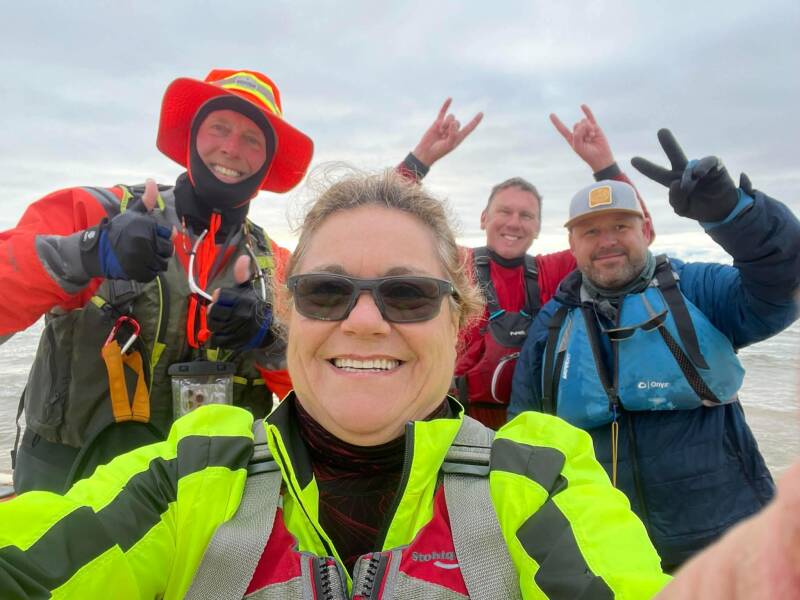
Members of the West Michigan Kayaking Club: Tim, Brad, James, and Susan.

If you'd like to join us on a paddle, please follow us on Facebook: https://www.facebook.com/groups/westmichigankayakingclub/
Wild Rivers. Rugged Trails. Real Adventure.
Business: West Michigan Kayaking Club
Phone: +1-616-328-5164
Read the complete expedition in one post: Muskegon River Adventure — 226 Miles
Add comment
Comments