By Brad D. De Young
Co-Founder, West Michigan Kayaking Club
Michigan Watershed Watch | The Kayaker's Journal
For generations, the Grand River has flowed through the heart of Grand Rapids, but the river running through the city has never quite lived up to the name of the community built along its banks.
The natural rapids that once defined this stretch of the Grand River were gradually replaced by low-head dams, changing the river's character, altering its aquatic habitat, and creating barriers to fish movement and recreational use.
Now, after nearly two decades of planning, advocacy, engineering, and community involvement, that relationship between the city and its river is beginning to change.
The Grand Rapids WhiteWater restoration project is bringing the rapids back.
A $14.5 million, two-season construction project is working to remove four low-head dams along the downtown stretch of the Grand River, restoring more natural river conditions between the Bridge Street and Fulton Street bridges. The project is expected to be completed in 2027.
Recent progress reports indicate that construction has reached approximately 75% completion, marking a significant milestone in one of West Michigan's most ambitious river restoration efforts.
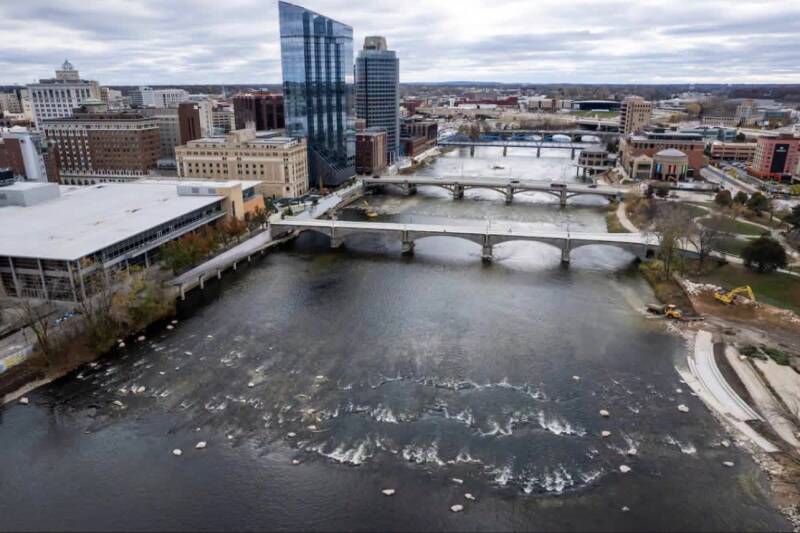
The Grand River in downtown Grand Rapids, where restored rapids and rock features are taking shape.
Restoring a River, Not Just Removing Dams
Dam removal is about much more than taking concrete out of a river.
For years, the four low-head dams have interrupted the natural flow of the Grand River, creating impounded sections of water and changing the habitat conditions that native fish and other aquatic species depend on.
The restoration project is designed to replace those structures with carefully engineered rock and boulder features that recreate the river's natural character.
Rather than simply allowing water to flow over a series of artificial barriers, the restored river will feature rapids, riffles, deeper pools, and resting areas for fish.
Approximately 125 large habitat boulders, some measuring four to six feet in diameter, are also being incorporated into the project.
These features will help create a greater diversity of aquatic habitat, providing shelter, resting areas, and improved conditions for native Great Lakes fish and mussel species.
The goal is to restore a healthier, more connected river system while bringing back some of the natural features that gave Grand Rapi
ds its name.
A New Opportunity for Kayakers and River Recreation
For those of us who spend our time exploring Michigan's rivers from a kayak, this project represents something particularly exciting.
The Grand River has tremendous recreational potential, but the downtown dams have historically created hazards and limited how people can safely experience this stretch of water.
Low-head dams are especially dangerous because of the powerful recirculating currents that can form below them. What may look like a relatively harmless drop in the river can create a hydraulic that traps swimmers, paddlers, and even boats.
Removing these structures eliminates those particular hazards and opens the door to a different kind of river experience.
The restored rapids will create opportunities for kayaking, canoeing, fishing, tubing, and other forms of recreation.
Instead of navigating a series of artificial impoundments, paddlers will be able to experience a more natural flowing river through the heart of downtown Grand Rapids.
For experienced paddlers, the prospect of having accessible whitewater features right in the middle of the city is especially appealing. For families and recreational users, improved access and the removal of dangerous dam structures could make the river a more inviting place to explore.
This is an opportunity to reconnect an entire community with one of its greatest natural resources.
An Environmental Investment in the Future
The environmental benefits may ultimately be even more important than the recreational opportunities.
Healthy rivers depend on movement. Fish need access to suitable spawning grounds, habitat diversity, and the ability to move through the watershed.
Dams can interrupt those natural processes, alter water temperatures, change sediment movement, and create conditions that favor some species over others.
By restoring rapids and creating a variety of pools and riffles, the Grand River project is intended to improve habitat diversity and conditions for native aquatic life.
The addition of large boulders will provide important structural habitat, while the restored flow will help recreate the changing water conditions that support a healthier river ecosystem.
It is an investment not just in downtown Grand Rapids, but in the long-term ecological health of the Grand River.
Two Dams Down, Two More to Go
The transformation is no longer just something seen in engineering plans and architectural renderings. It is happening right in the middle of downtown Grand Rapids.
According to a November 15, 2026 report by MLive, crews have removed two of the four low-head dams, and approximately 23,000 tons of rock and boulders have been placed in the river.
Water is already flowing around the newly constructed rock features, offering a glimpse of what the restored Grand River will look like when the project is finished.
The work is being completed in phases, with construction concentrated during seasonal work windows. The $14.5 million contract was awarded to the Taplin Group, and the overall project is expected to take two construction seasons, with completion anticipated in 2027.
The four structures being removed are located between Bridge Street and Fulton Street. It is important to distinguish this project from the separate, future effort involving the Sixth Street Dam, which serves as a sea lamprey barrier. That upper-reach project requires additional environmental study and planning.
The History Behind the Rapids
The name Grand Rapids is not accidental.
Long before the city became an industrial and commercial center, this stretch of the Grand River was known for its natural rapids. The river's powerful currents and rocky channels helped define the landscape and influenced the development of the community.
The rapids were an important part of the region's history, including their significance to Indigenous communities who lived along and traveled the river for generations.
As Grand Rapids developed, dams and other infrastructure fundamentally changed the river.
The restoration effort represents an opportunity to recover a portion of that natural character while creating a riverfront that serves the needs of a modern community.
The project also recognizes that rivers are more than waterways running through cities. They are living ecosystems, recreational resources, and important connections between communities and the natural world.
A Bigger Picture for Michigan's Rivers
As someone who spends considerable time paddling Michigan's rivers, I believe projects like this deserve attention well beyond the boundaries of Grand Rapids.
Across Michigan, communities are beginning to reconsider the long-term value of aging dams and the impact these structures have on aquatic ecosystems, fish passage, public safety, and recreation.
Dam removal is not always the appropriate solution for every location. Each project requires careful environmental evaluation, engineering, consideration of public safety, and community involvement.
But where removal makes sense, the benefits can extend far beyond the immediate construction site.
Restoring natural river flow can improve habitat, reconnect portions of a watershed, create new recreational opportunities, and give communities a reason to rediscover their waterways.
The Grand River project is a particularly visible example of what can happen when local advocates, environmental organizations, government agencies, engineers, and community members work toward a shared vision.
It also demonstrates the importance of long-term persistence. This project spent nearly two decades moving from an idea to construction. Meaningful river restoration rarely happens overnight.
Looking Ahead: A River Worth Exploring
For Michigan's paddling community, the next chapter of the Grand River is something worth watching.
Imagine launching a kayak in downtown Grand Rapids and experiencing a river that once again features flowing rapids, rocky riffles, deeper pools, and improved aquatic habitat.
Imagine families gathering along the river, anglers pursuing native fish, and paddlers discovering a natural feature that had been hidden behind concrete structures for generations.
That is the promise of this restoration.
Of course, a restored river is still a river. Paddlers will need to understand water levels, currents, changing conditions, and the characteristics of the newly constructed rapids. The removal of low-head dams does not eliminate all river hazards, and new features will require appropriate assessment before paddlers attempt them.
But the opportunity is significant.
The Grand River has always been one of West Michigan's most important natural resources. Restoring its rapids is about more than improving the appearance of downtown. It is about restoring ecological function, improving public access, and giving future generations a stronger connection to the water.
As the remaining dams come out and construction continues toward its anticipated 2027 completion, Grand Rapids is getting closer to reclaiming a piece of its natural identity.
Sometimes moving forward means taking something away.
In this case, it means removing concrete so a river can flow more naturally again.
The rapids that gave Grand Rapids its name are coming back. And for those of us who love Michigan's rivers, that's something worth celebrating.
Sources and Further Reading
MLive — November 15, 2026, coverage of the Grand River restoration project's construction progress.
Grand Rapids WhiteWater: https://grandrapidswhitewater.org/
Michigan Public: https://www.michiganpublic.org/
Brad D. De Young writes about Michigan rivers, paddling, conservation, and outdoor adventure for Michigan Watershed Watch and The Kayaker's Journal.
Add comment
Comments