Muskegon River Number 10, the finale: the West Michigan Kayaking Club completes its 226-mile Muskegon River journey, paddling from Maple Island to Lake Michigan on November 15, 2026.
Muskegon River Expedition No. 10: Maple Island to Pere Marquette Park
November 15, 2026 | West Michigan
By Brad D. De Young
Cofounder, West Michigan Kayaking Club
The Kayaker’s Journal
Some adventures are measured in miles. Others are measured in friendships, memories, challenges, and the people who share the journey with you.
And then there are adventures that give you all of those things.
On November 15, 2026, Tim Postma and I set out to accomplish something we had been working toward for a long time: completing the entire 226-mile Muskegon River journey, from its headwaters near Houghton Lake to its mouth at Lake Michigan.
As cofounders of the West Michigan Kayaking Club, we have spent countless hours exploring Michigan’s waterways, bringing paddlers together, and encouraging others to discover the incredible adventures waiting right here in our own backyard.
But this journey was personal.
We weren’t just setting out for another day of kayaking. We were preparing to complete an expedition that had taken us through hundreds of miles of Michigan river country. We were about to paddle the final chapter.
Our starting point was Maple Island Boat Launch. Our destination was Pere Marquette Park in Muskegon, where the Muskegon River’s journey eventually meets the waters of Lake Michigan.
Between those two points were approximately 20 miles of paddling, a transition through Muskegon Lake, and a final passage through the Muskegon Channel.
At the end of the day, we would have completed something truly special.
226 miles. One river. One unforgettable adventure.
6:23 A.M. — Coffee, 37 Degrees, and One Last Launch
November 15, 2026. The time was 6:23 a.m., and the overnight temperature was a surprisingly balmy 37 degrees.
For November in West Michigan, we couldn’t complain.
There is something special about those early mornings before a big adventure. The world is still quiet, the coffee tastes a little better, and there’s that familiar excitement of knowing you’re about to spend the day doing something you love.
Tim and I grabbed some coffee and headed toward Maple Island Boat Launch, where we would meet our paddling companions.
Starting location: Maple Island DNR Boat Launch
Bridgeton Township, Newaygo County, Michigan
GPS coordinates: 43.318397° N, 86.033468° W
Maple Island is a public Michigan Department of Natural Resources boat access on the lower Muskegon River. It is an important access point for recreational boaters, anglers, and paddlers exploring this section of the river.
For us, Maple Island represented something much bigger than another boat launch.
It was the starting point of our final push toward Lake Michigan.
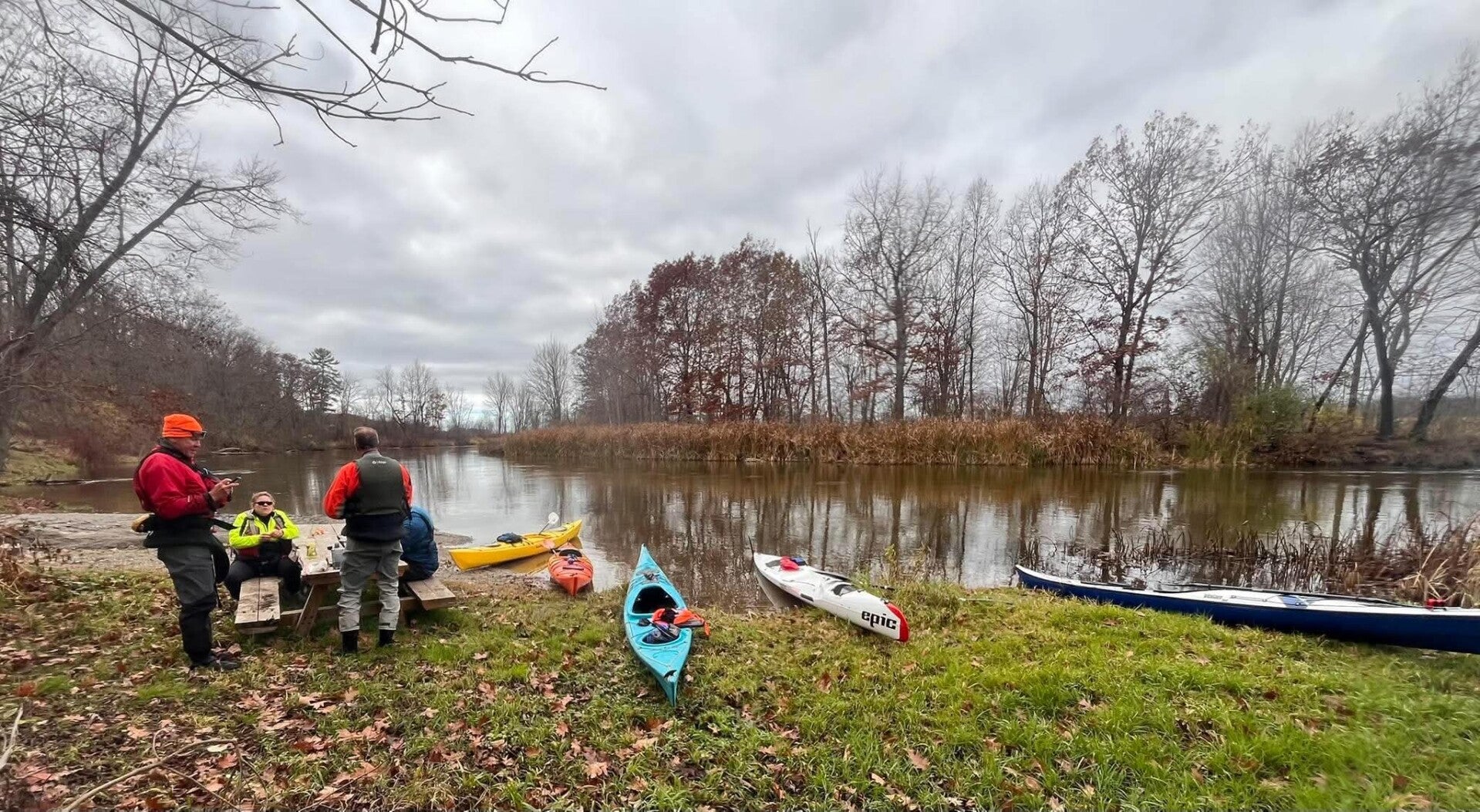
Staging boats at the Maple Island boat launch on the lower Muskegon River — ready for the final leg to Lake Michigan.
Understanding the River: Water Levels, CFS, and the Current
One of the important considerations when planning a longer river expedition is understanding water conditions.
River discharge is often discussed in terms of CFS, or cubic feet per second. CFS measures the volume of water passing a particular point in the river every second. It provides useful context about river conditions, although factors such as river width, depth, gradient, and local conditions also influence how the water behaves.
For our November 15 expedition, the available USGS flow information near Croton provided an additional reference for conditions on the Muskegon River.
The reported discharge was approximately 1,690 CFS.
This reading provides upstream river-flow context rather than a direct measurement at Maple Island.
The river had been flowing well in the preceding weeks, and we were fortunate to have a healthy current helping us downstream.
During the moving-water portions of the expedition, we maintained a reported paddling pace of approximately 5.5 miles per hour.
That’s a respectable pace for a November river adventure.
There is a difference between simply paddling hard and finding the rhythm of a river. When the current, your paddle strokes, and the boat all work together, the miles seem to disappear beneath you.
And on this particular morning, the Muskegon was helping us get where we wanted to go.
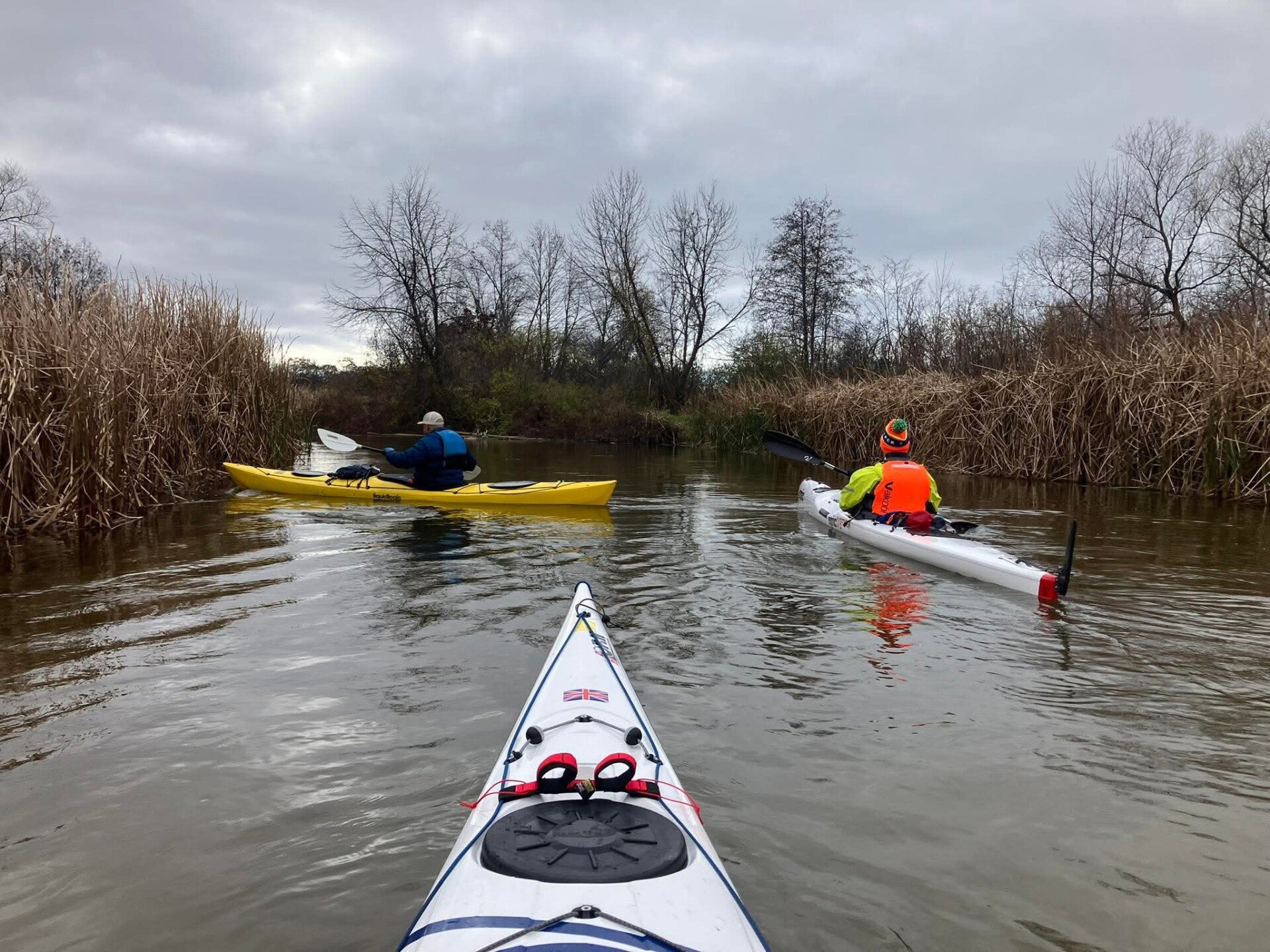
On the lower Muskegon River below Maple Island, paddling reed-lined water toward Muskegon Lake.
The Lower Muskegon: A Changing Landscape
The lower Muskegon River has a character all its own.
As you travel downstream, the surrounding landscape changes. The river winds through wooded corridors, wetlands, and increasingly developed areas before eventually opening into the expansive waters of Muskegon Lake.
For paddlers, this transition is one of the most interesting aspects of the journey.
A river is constantly changing. The current moves differently around bends, the banks open and close, and the surrounding scenery offers something new around every corner.
By the time you reach the lower river, you begin to feel the influence of the Great Lakes.
You’re no longer simply following a river through the countryside. You’re approaching one of the largest freshwater systems in the world.
For Tim and me, every mile was another reminder of how fortunate we are to have waterways like this in Michigan.
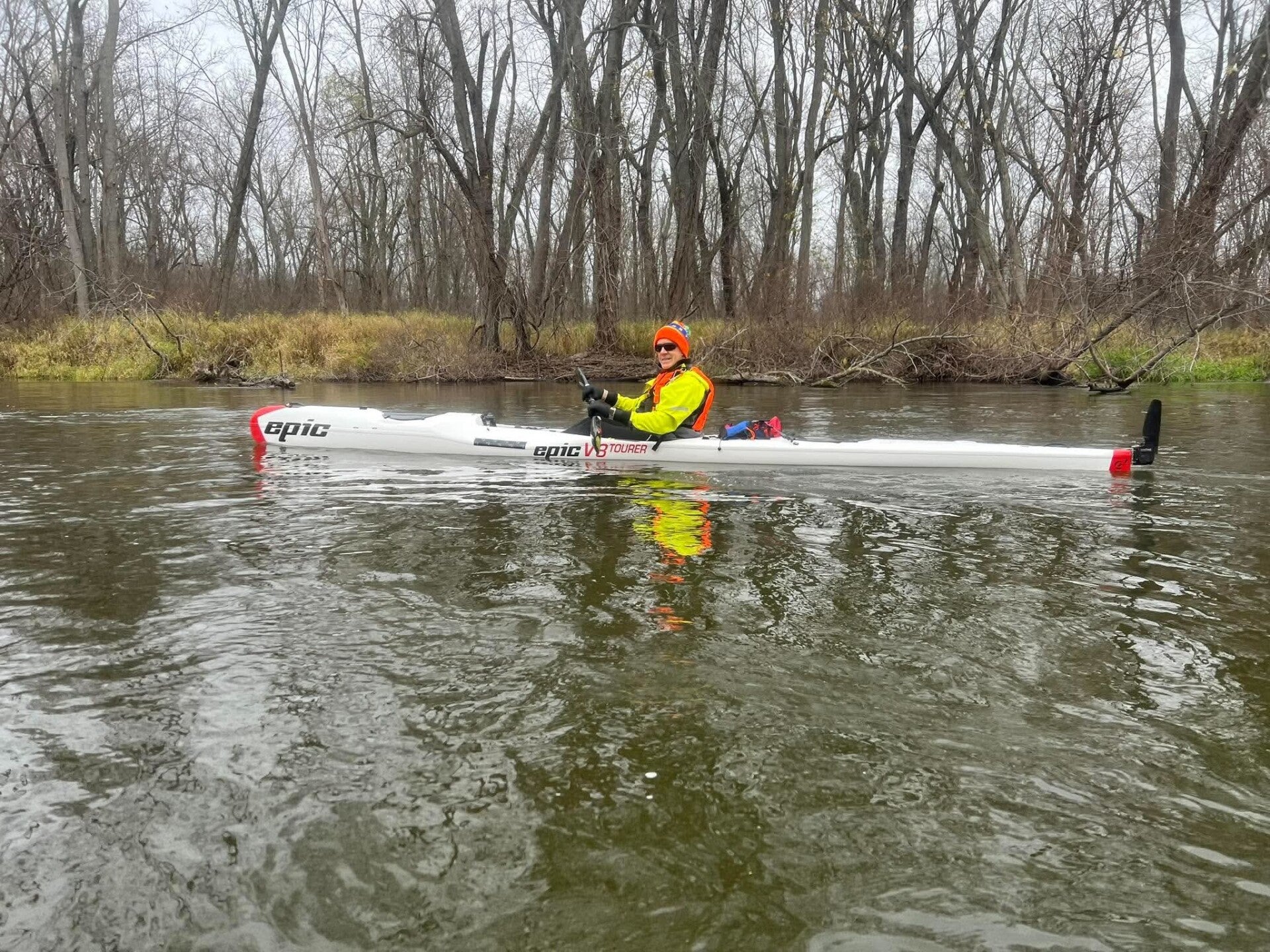
A club paddler in an Epic surf ski on the calm lower Muskegon River.
Good Friends Make Great Adventures
Tim and I weren’t alone for this final chapter.
We were fortunate to have experienced paddlers James Bruce and Susan make the drive to join us.
Having good friends along made the day even more meaningful.
One of the things I appreciate most about kayaking is how quickly people can develop friendships through shared adventures.
You might meet someone at a boat launch, exchange a few words, and spend the next several hours navigating the same waterway. Before long, you’re sharing stories, comparing experiences, and creating memories.
That’s one of the things that makes the kayaking community so special.
We made one brief stop along the way, taking approximately 20 minutes to use the restroom, stretch our legs, and enjoy a little lunch before getting back into our boats.
There is something satisfying about a quick break during a longer paddle. You get a chance to appreciate where you are, take a breath, and prepare for the next section.
But we still had one significant part of the journey ahead.
Muskegon Lake.
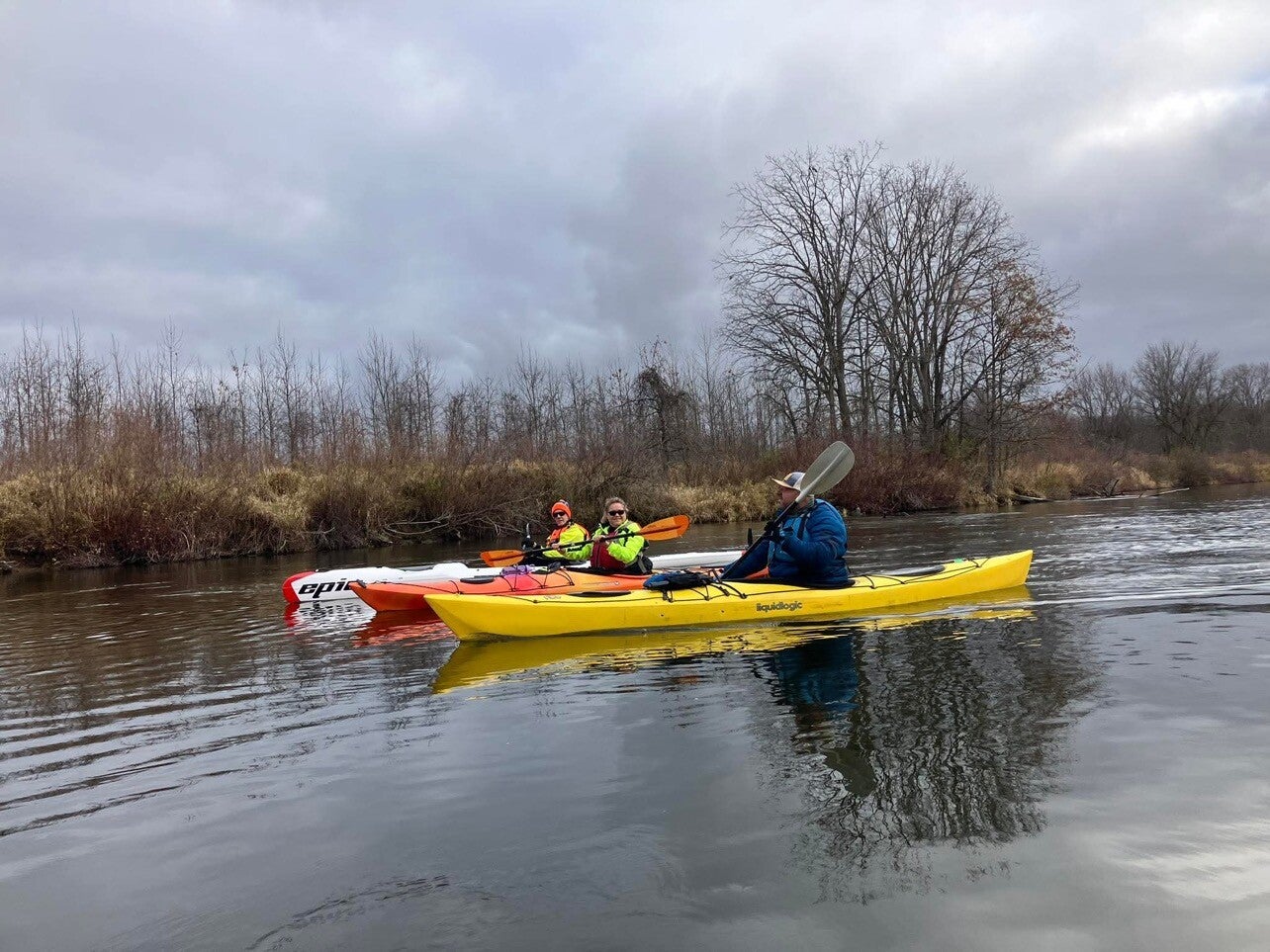
The group rafted up on the lower river — a short break before the Muskegon Lake crossing.
From River to Lake: Entering Muskegon Lake
Reaching Muskegon Lake is a significant milestone for anyone paddling the lower Muskegon River.
The river eventually opens into Muskegon Lake, a large freshwater body connected to Lake Michigan through the Muskegon Channel.
This is where the character of the adventure changes.
River paddling and open-water kayaking are two different experiences.
On a river, the current generally helps determine your direction of travel. On a lake, wind, waves, fetch, boat traffic, and changing weather become much more important considerations.
Muskegon Lake covers roughly 4,150 acres and is approximately five miles long. It is an important recreational and commercial waterway supporting boating, fishing, sailing, and commercial navigation.
For kayakers, the open-water environment deserves respect.
Even when the surface looks relatively calm, wind can create conditions very different from those experienced on a protected river. Waves can build across open stretches of water, and the absence of riverbanks means fewer natural places to shelter.
Boat traffic is another consideration. Muskegon Lake supports recreational vessels as well as commercial marine traffic. Paddlers need to remain visible, maintain awareness of their surroundings, and avoid interfering with navigational routes.
Fortunately, we had been given a very favorable day.
The wind was unusually light for November, and Muskegon Lake was remarkably calm. We encountered very little wave activity, making the transition from the river to the lake much more manageable.
We did experience some rain, but overall the weather cooperated.
There is something special about paddling into a large lake after following a river for so many miles.
The shoreline opens up, the water stretches farther toward the horizon, and you begin to realize that the river that carried you here is finally reaching its destination.
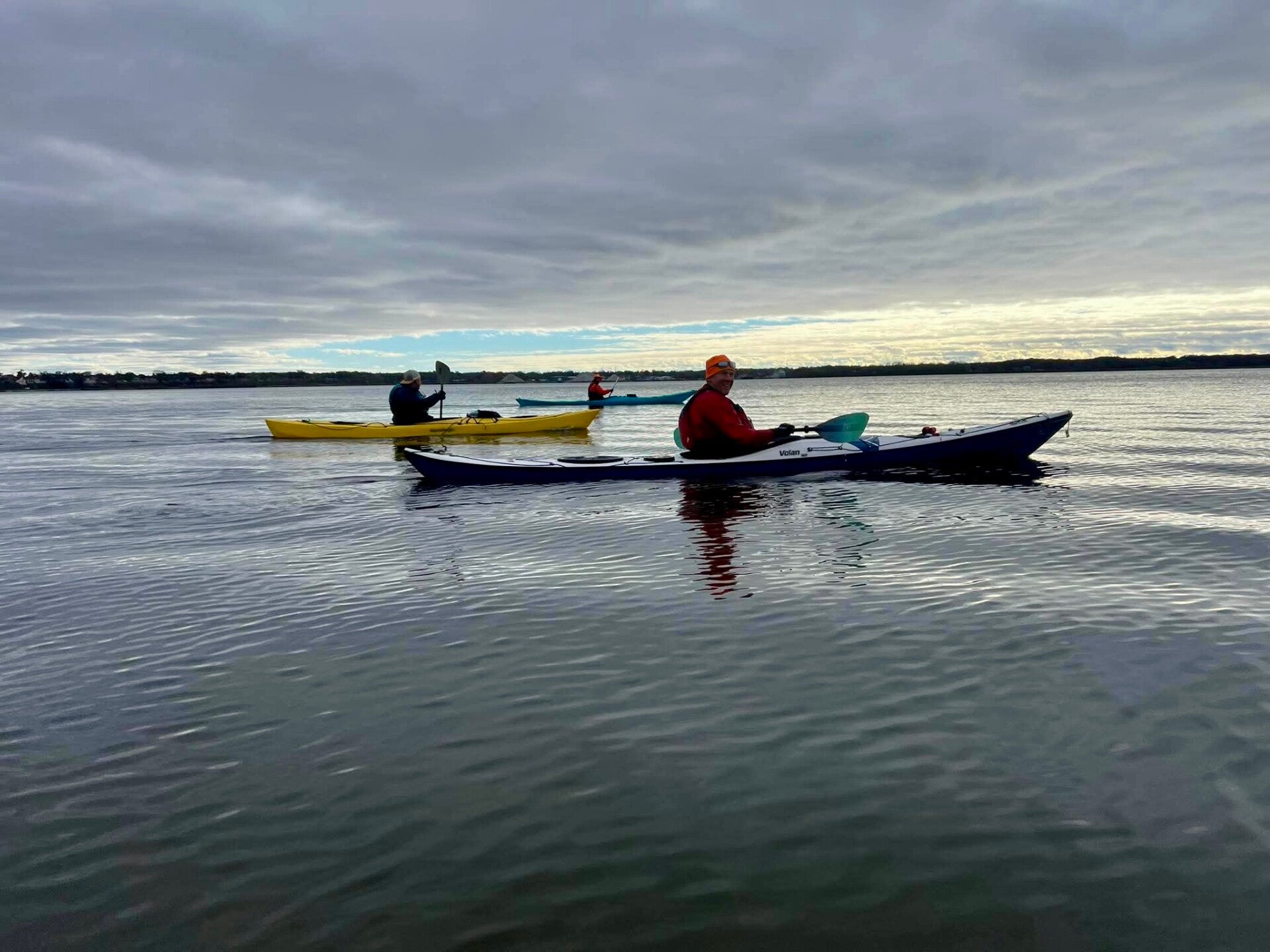
Crossing Muskegon Lake — where the river gives way to open water.
The Muskegon Channel: The Gateway to Lake Michigan
Between Muskegon Lake and Lake Michigan is the Muskegon Channel.
This navigational channel connects the inland lake directly to Lake Michigan and serves as an important transportation corridor.
It is used by commercial freighters, tugboats, recreational vessels, fishing boats, and the Lake Express high-speed ferry service connecting Muskegon with Milwaukee.
The channel is also home to the historic Muskegon breakwater lights.
For kayakers, this is an area that requires particular attention.
Commercial vessels have limited maneuverability compared with a kayak, and their operators may have difficulty seeing smaller craft in the water.
A few important considerations for paddlers in this area include:
● Stay well clear of commercial shipping lanes and vessel approaches.
● Remain visible and maintain awareness of boat traffic.
● Understand the direction of wind and waves before entering exposed water.
● Wear a properly fitted personal flotation device.
● Monitor weather conditions and changing lake conditions.
● Never assume a large vessel can see or maneuver around a kayak.
Even on a calm day, the channel deserves respect.
For us, the favorable November weather made this portion of the adventure much more manageable.
The light winds and relatively calm water were a welcome gift after the miles we had already covered.
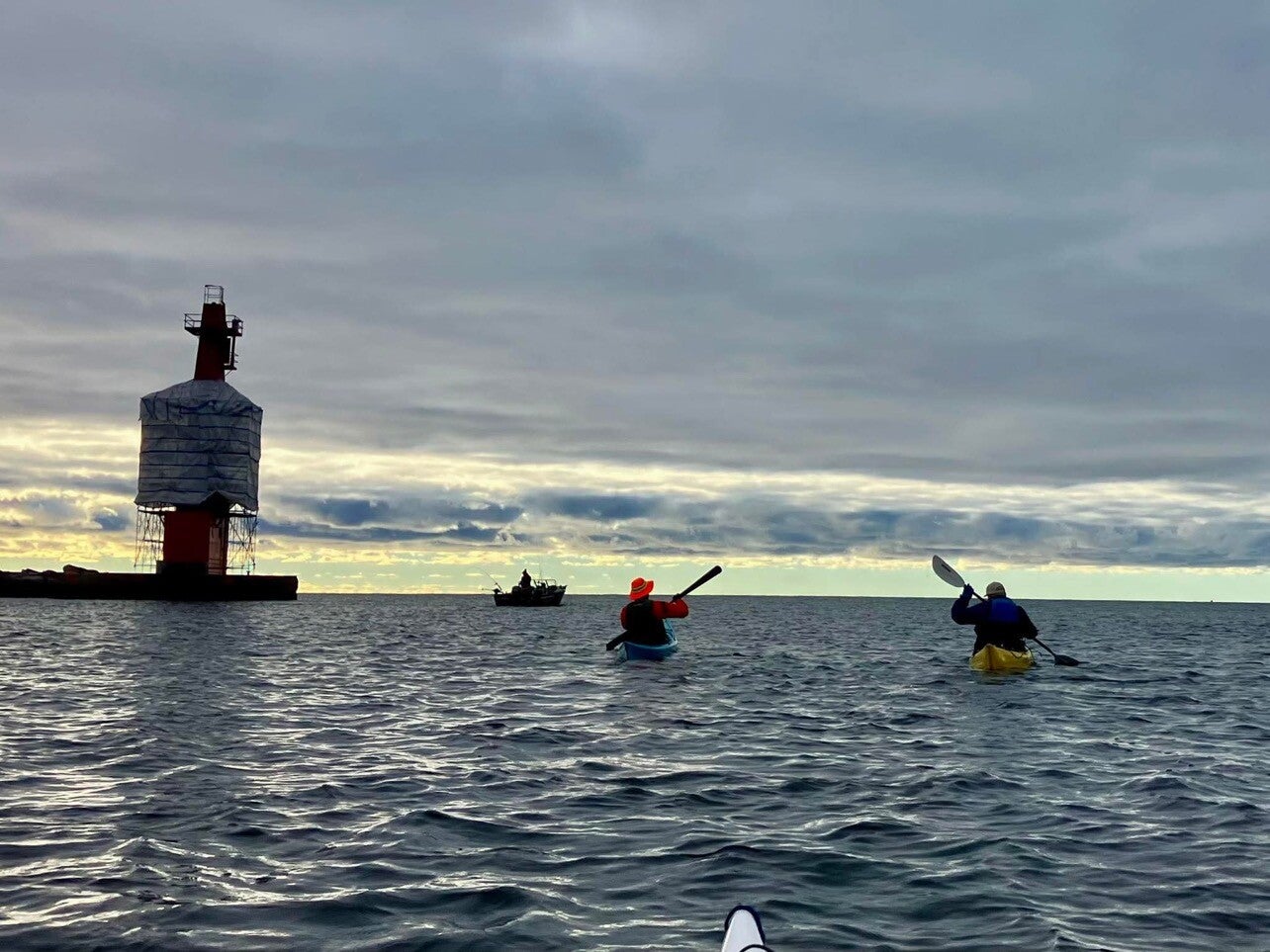
Passing the Muskegon South Pierhead Light — wrapped for restoration — on the way out to Lake Michigan.
Lake Michigan: The Finish Line
There is something difficult to describe about reaching Lake Michigan after following a river for hundreds of miles.
The Muskegon River eventually gives way to Muskegon Lake, and beyond that lies the open water of Lake Michigan.
For us, arriving at Pere Marquette Park represented the completion of a journey that had been built one paddle stroke at a time.
Our destination: Pere Marquette Park
3510 Channel Drive
Muskegon, Michigan 49441
Approximate GPS coordinates: 43.22389° N, 86.34778° W
Pere Marquette Park sits along the Lake Michigan shoreline near the mouth of the Muskegon Channel. Its beach, breakwater, lighthouse, and expansive Great Lakes views make it a fitting destination for a long-distance paddling adventure.
The final approach brought us to the place where the Muskegon River’s journey meets the Great Lakes.
Think about that for a moment.
Water that began its journey far inland eventually finds its way here.
And on November 15, we had followed it.
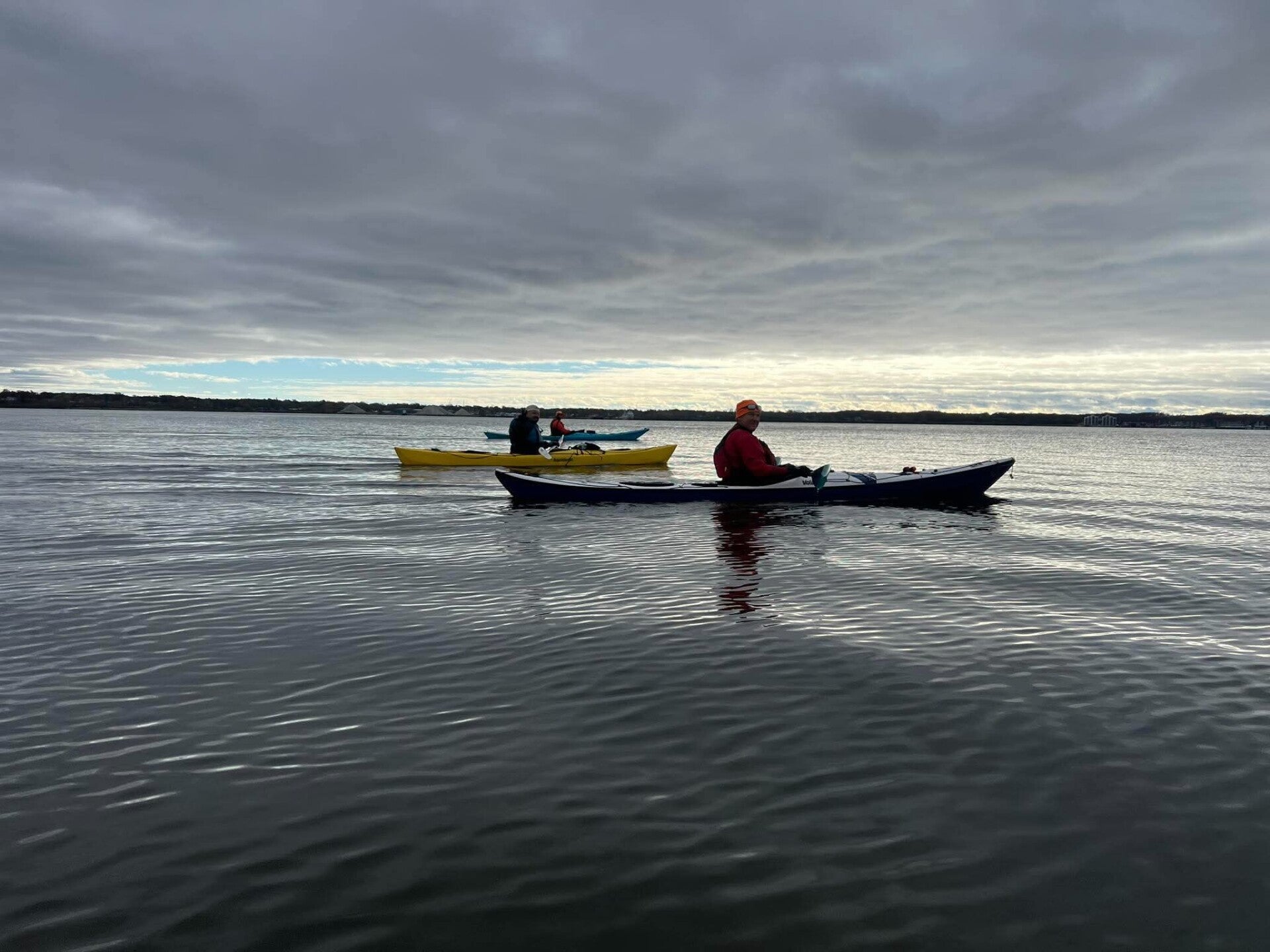
On Muskegon Lake under a heavy November sky, closing in on the channel.
A November Adventure: Why the Weather Mattered
November kayaking in Michigan is not something to take lightly.
Water temperatures are considerably colder than during the summer months, daylight hours are shorter, and weather can change quickly.
For this particular trip, we were fortunate.
The overnight temperature was approximately 37 degrees, and although we experienced some rain, the wind remained relatively light.
Muskegon Lake was calm, with very little wave activity.
These conditions made a significant difference during the open-water portion of our route.
Cold-weather paddling requires preparation beyond what is necessary for a typical summer outing.
Proper clothing, including insulating layers and appropriate immersion protection, becomes increasingly important. A properly fitted PFD, communication equipment, navigation tools, and a realistic understanding of the weather are essential.
Open-water crossings also require a willingness to change plans if conditions deteriorate.
We were fortunate that the weather cooperated, but the lesson is always the same: respect the water, understand the conditions, and never underestimate the Great Lakes.
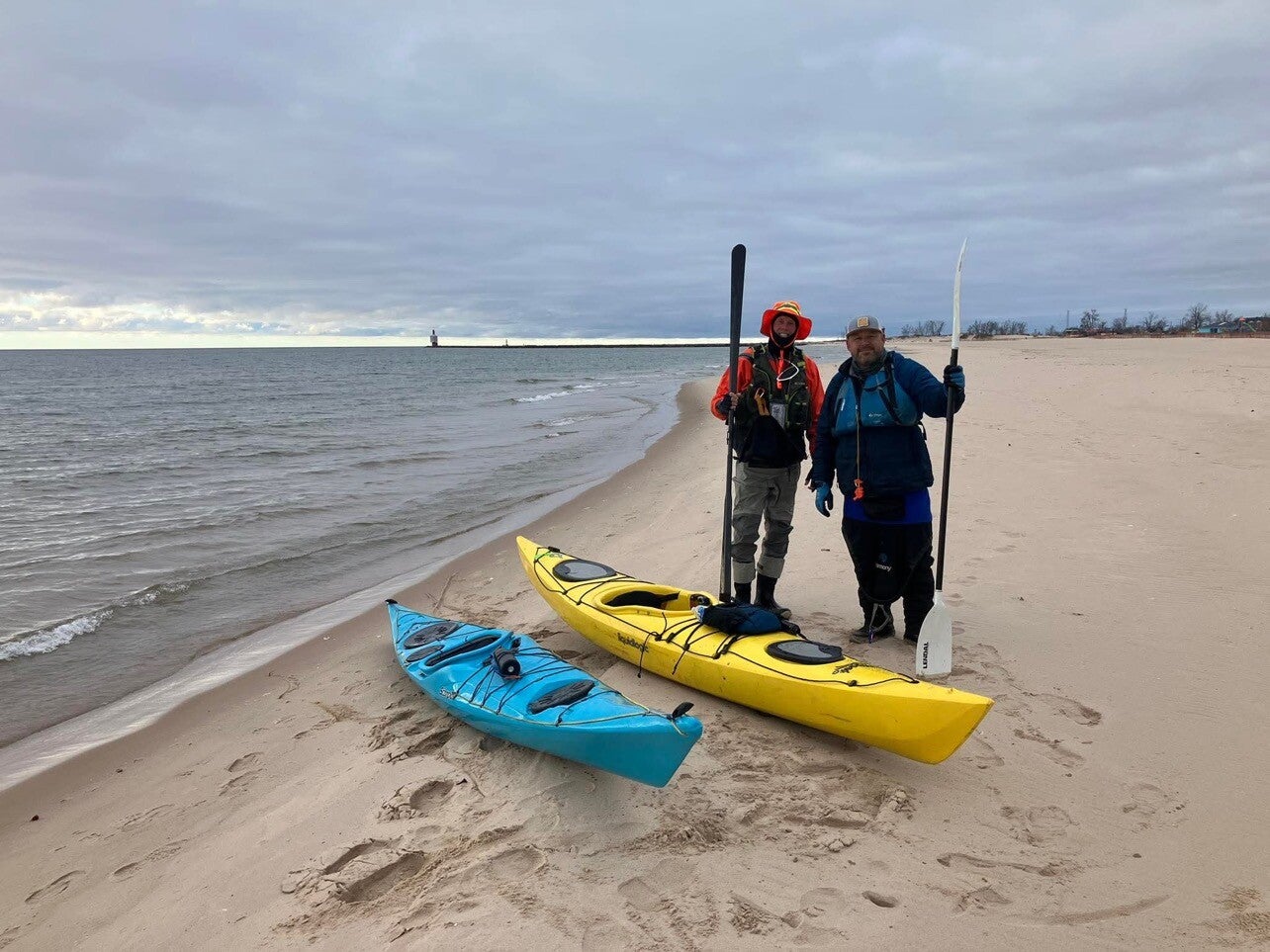
Tim Postma and Brad De Young at Pere Marquette Park beach, completing the Muskegon River journey.
226 Miles: More Than Just a Number
When Tim and I first set out to complete the Muskegon River, we knew it would be a substantial undertaking.
Two hundred and twenty-six miles is a lot of river.
It represents countless paddle strokes, early mornings, long days, changing weather, and the commitment to keep moving toward a destination.
But looking back, the mileage is only part of the story.
It’s the people who joined us along the way.
It’s the conversations at boat launches, the shared experiences, the unexpected friendships, and the incredible scenery that Michigan’s waterways offer.
Some paddlers joined us for shorter stretches. Others shared longer sections of the journey.
Every person who joined us became part of the adventure.
For Tim and me, completing the entire Muskegon River was an incredibly rewarding and bittersweet experience.
There is tremendous satisfaction in accomplishing something that takes so much time and effort. At the same time, there’s a little sadness when a journey you’ve spent so much time working toward finally comes to an end.
You realize that it wasn’t just about reaching Lake Michigan.
It was about everything that happened between the headwaters and the shoreline.
And I wouldn’t trade those memories for anything.
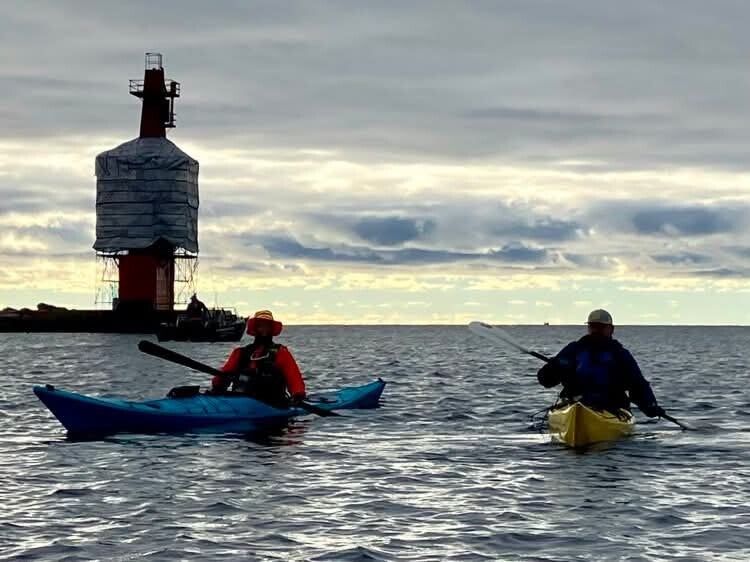
Two of the group paddling past the Muskegon South Pierhead Light at the channel mouth.
The Reason We Started the West Michigan Kayaking Club
When Tim Postma and I cofounded the West Michigan Kayaking Club, our goal was to bring people together through a shared love of paddling, exploration, and outdoor adventure.
We wanted to create opportunities for people to discover Michigan’s waterways, challenge themselves, and experience the outdoors with others who share the same passion.
This 226-mile Muskegon River expedition represents so much of what we believe in.
It’s about getting beyond the ordinary.
It’s about discovering new places, exploring our state’s natural resources, and making friendships that extend well beyond the water.
And it’s about appreciating the incredible natural heritage we have right here in Michigan.
Our rivers are more than recreational destinations. They are living waterways that support wildlife, connect communities, and contribute to the environmental health of our state.
As kayakers, we have a unique opportunity to experience these places firsthand. That experience also gives us a responsibility to respect and protect them.
The Muskegon River gave us 226 miles of memories.
That’s something worth celebrating.
The River May End, But the Adventures Continue
On November 15, 2026, we completed the entire Muskegon River journey, from its headwaters near Houghton Lake to Lake Michigan.
One river. Hundreds of thousands of paddle strokes. Countless memories. And friendships that made every mile worthwhile.
To James Bruce, Susan, and everyone who joined us along the way, thank you.
Your participation helped make this journey what it was.
And to Tim, thank you for being there from beginning to end. Some adventures are simply better when you have a good friend alongside you.
The Muskegon River may be behind us, but the adventures of the West Michigan Kayaking Club are far from over.
There are more rivers to explore, more miles to paddle, more trails to hike, and more friendships waiting to be made.
Because the best thing about finishing one great adventure is knowing that another one is waiting.
The river may have ended at Lake Michigan, but our next adventure is already around the next bend.
226 miles. One river. A lifetime of memories. November 15, 2026.
Brad D. De Young
Cofounder, West Michigan Kayaking Club
The Kayaker’s Journal
Tim Postma
Cofounder, West Michigan Kayaking Club
Wild Rivers. Rugged Trails. Real Adventure.
Come explore Michigan with us:
● Website: https://www.westmichigankayakingclub.com
● Facebook: https://www.facebook.com/share/g/1BzMvdB4FU/?mibextid=wwXIfr
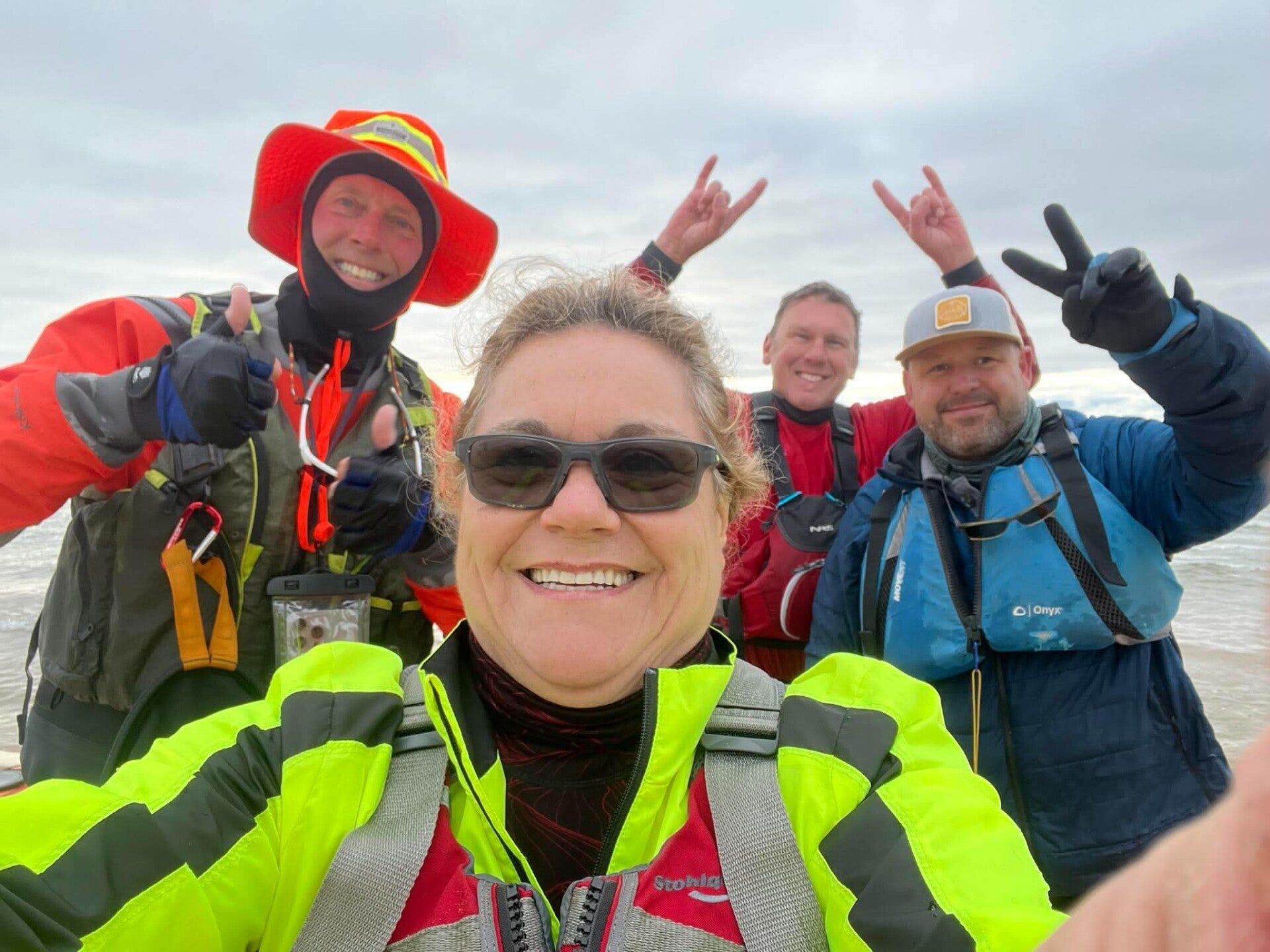
Members of the West Michigan Kayaking Club: Tim, Brad, James, and Susan.

If you’d like to join us on a paddle, please follow us on Facebook:
https://www.facebook.com/groups/westmichigankayakingclub/
Wild Rivers. Rugged Trails. Real Adventure.
Read the complete expedition in one post: Muskegon River Adventure — 226 Miles